Meet the Rangers
The Rangers are Ollie’s guides, helpers, and teachers out in the wild. They’re the ones who know the paths, understand the animals, and love sharing what they’ve learned with children.
All four Rangers are in their late teenage years, and they didn’t become experts overnight — they became Rangers because they cared, kept asking questions, and never stopped learning.

Select a ranger to find out more.
Ranger Lisa – The Calm One
Ranger Lisa is thoughtful, gentle, and very observant.
She’s brilliant at noticing small details, a broken twig, a nervous animal, or a change in the weather, things others might walk straight past.
At school, Lisa loved:
- Biology
- Science
- Art (especially drawing animals and plants)
She wasn’t very keen on:
- Maths
- Big noisy group work
Lisa believes that nature teaches best when we slow down and listen. She’s especially good at helping injured animals recover and teaching children how to be patient and kind when exploring the outdoors.
“If you stay quiet long enough,” Lisa says, “the world starts explaining itself.”
Ranger Danny – The Energetic One
Ranger Danny is fun, noisy, and always moving.
He laughs easily, climbs trees when he probably shouldn’t, and has an amazing connection with playful animals, especially monkeys, chimpanzees, and young creatures who like to cause mischief.
At school, Danny loved:
- Physical Education
- Drama
- Outdoor learning
He didn’t enjoy:
- Sitting still
- Writing long essays
Danny proves that learning doesn’t always happen at a desk. He teaches children through movement, games, and laughter — and reminds them that joy is an important part of nature too.
“If animals can learn through play,” Danny says, “so can we.”
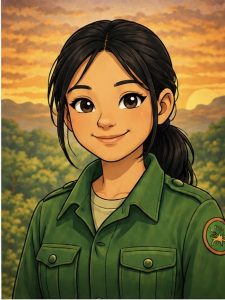
Ranger Emi – The Caring One
Ranger Emi is warm, brave, and deeply caring.
She works closely with rescued and vulnerable animals and is often the first to notice when something — or someone — needs help.
At school, Emi loved:
- Geography
- Health and Social Studies
- English (especially stories with meaning)
She struggled with:
- Tests
- Timed exams
Emi believes every animal deserves a second chance and helps children understand how human actions affect wildlife. She’s especially passionate about conservation, rescue work, and protecting smaller animals.
“Looking after the world,” Emi says, “starts with looking after each other.”
Ranger Malik – The Navigator
Ranger Malik loves maps, trails, and planning routes.
He always knows where the group is, where they’re going, and how to get everyone home safely — even when the weather turns or the path disappears.
At school, Malik enjoyed:
- Geography
- Maths
- Problem-solving challenges
He didn’t love:
- Art
- Creative writing
Malik teaches children that preparation matters — and that understanding the land helps protect it. He’s brilliant at explaining landscapes, ecosystems, and how humans fit into the bigger picture.
“The land remembers where you walk,” Malik says. “So choose your path wisely.”
Friday Fun Facts
Fun Fact 1 - Why maps are never perfect
Have you ever noticed that different maps of the world don’t all look the same? Some make countries look huge, others make them seem smaller, and none of them are actually wrong.
That’s because maps are never perfect copies of our Earth. The Earth is round, but maps are flat. To turn a sphere into a flat picture, something always has to change. Some maps stretch the land near the top and bottom, making places like
Greenland look enormous. Others squash areas near the equator. Some protect shapes, others protect distances, and some try to balance everything, but no map can do it all.
That’s why explorers, sailors, hikers, and rangers use different kinds of maps for different jobs. A walking map needs accurate paths and heights. A world map is better for showing where places are in relation to each other. Even digital maps make choices about what to show and what to leave out.
Why it matters:
Maps help us understand the world, but they also remind us that perspective matters. How we look at something can change what we think we see, in geography, and in life too.

Ranger Malik
(Land, Maps & Geography)
Fun Fact 2 - Why Nature Loves Patterns
Once you start looking for patterns in nature, you see them everywhere. From the spirals in pinecones to the stripes on zebras and the way leaves grow on a stem, nature seems to enjoy repeating itself.
These patterns aren’t just there to look nice, they help things work better. Spirals, for example, allow plants to pack seeds tightly while still giving each one room to grow. Stripes and spots can help animals blend into their surroundings or confuse predators. Even snowflakes follow patterns, forming six-sided shapes every time they freeze.
Nature also loves patterns because they save energy. Growing in repeating shapes is efficient and reliable. Instead of reinventing the design every time, nature uses the same successful ideas again and again. That’s why we see similar patterns in shells, hurricanes, galaxies, and even fingerprints.
You can spot patterns in how animals migrate, how seasons change, and how rivers branch out like tree roots. Once you notice them, you’ll realise patterns are one of nature’s favourite tools.
Why it matters:
Patterns help us understand how the natural world works. When we recognise them, we can predict changes, protect habitats, and appreciate just how clever nature really is.

Ranger Lisa
(Organisation & Clever Facts)
Fun Fact 3 - Why Worms Are More Important Than They Look
Worms might not be the first animals people get excited about, but they are some of the most important creatures on Earth. Even though they spend most of their lives underground, worms quietly help almost everything above them.
As worms move through the soil, they create tiny tunnels that let air and water reach the plant roots all around them. This helps the plants grow stronger and healthier. Worms also eat dead leaves and plant matter, breaking it down into rich soil that plants can use. What they leave behind is called worm castings, and it’s one of the best natural fertilisers there is.
Without worms, soil can become hard, dry, and poor in nutrients. Gardens struggle, forests grow more slowly, and food becomes harder to grow. Birds, hedgehogs, and many other animals also rely on worms as a vital food source, which means worms support whole food chain.
They don’t make any noise and they don’t demand attention, in fact they shy away from it. But they work constantly, doing a job most of us never even notice they do.
Why it matters:
Worms remind us that small creatures can have a huge impact on our lives. Looking after the tiniest parts of nature helps protect everything else too.
Ranger Emi
(Small Animals & Empathy)